Charting Cross-Device Session Flows and Their Impact on Offer Redemption Rates in Browser-Based Reel Networks
Written by Freya Fischer · Jun 17, 2026
Charting Cross-Device Session Flows and Their Impact on Offer Redemption Rates in Browser-Based Reel Networks
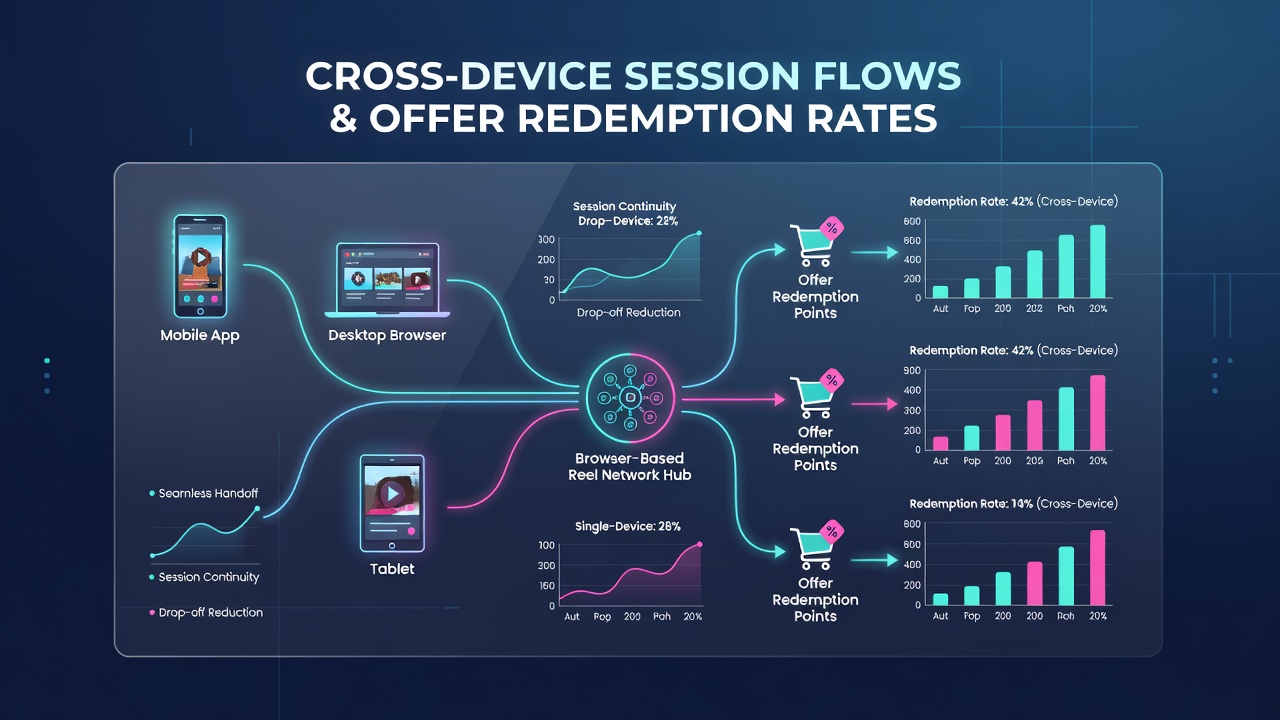
Browser-based reel networks operate through continuous user sessions that span multiple devices, and charting these flows requires mapping identifiers such as cookies, device fingerprints, and login tokens as players move between smartphones, tablets, and desktops during a single engagement period. Researchers collect timestamped data points at each transition point, which allows platforms to reconstruct complete journeys from initial login through reel spins and offer interactions, while data from industry reports indicates that incomplete session mapping often leads to fragmented offer visibility and lower redemption completion rates.
Methods for Mapping Session Transitions
Developers implement server-side logging combined with client-side beacons to capture device switches in real time, and these systems record parameters including IP address changes, browser agent strings, and authentication events that link separate touchpoints into unified profiles. Studies conducted through mid-2026 show that networks employing unified ID frameworks achieve higher accuracy in tracing paths compared with those relying solely on local storage, because persistent tokens survive cache clears adn app switches more reliably than temporary variables. Observers note that integration of these logs with offer engines enables precise attribution of redemptions back to originating devices, which supports adjustments in bonus timing and presentation formats across different screen sizes.
Data Patterns Observed in 2026
Analysis of aggregated logs from several large reel platforms during the first half of 2026 reveals that approximately 62 percent of active sessions involve at least one device transition before an offer reaches the redemption stage, and sessions crossing from mobile to desktop demonstrate redemption rates roughly 18 percent higher than single-device mobile-only flows. Figures released by the Australian Gambling Research Centre highlight similar cross-device uplift in promotional uptake when players maintain logged-in states, whereas abrupt logouts during switches correlate with offer abandonment spikes of up to 27 percent. Platforms adjust incentive delivery schedules based on these observed sequences, timing push notifications or in-browser prompts to coincide with likely device arrival points.
Techniques such as graph-based visualization tools help analysts plot node-to-node movement frequencies, and heat maps generated from June 2026 datasets illustrate peak transition hours between 8 p.m. and 11 p.m. local time across multiple time zones. These visualizations also flag friction points where session continuity breaks, such as failed token refreshes on older browser versions, which directly suppress subsequent offer engagement metrics.
Effects on Offer Redemption Metrics
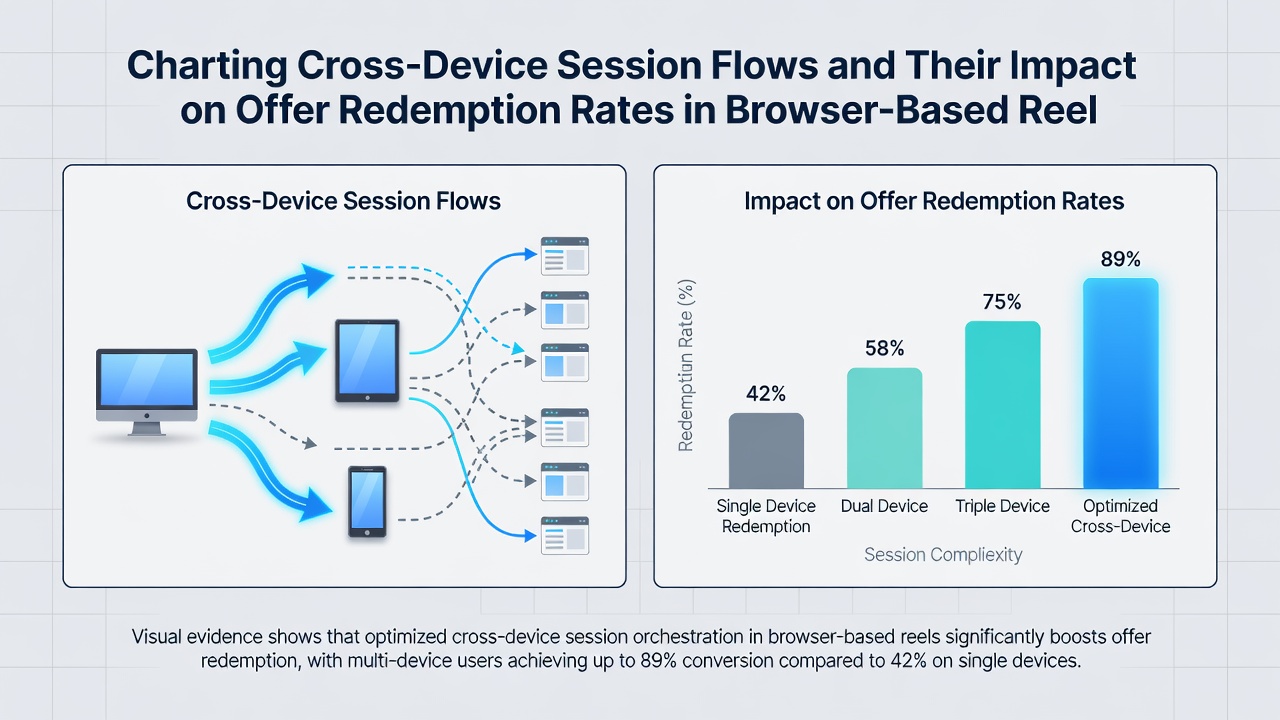
Redemption rates respond measurably to the completeness of session continuity, because offers presented mid-flow retain higher perceived relevance when context from prior device activity carries forward without interruption. Quantitative reviews compiled by the Nevada Gaming Control Board through early June 2026 document that reel networks maintaining persistent session states across devices record average redemption lifts between 14 and 22 percent compared with fragmented tracking implementations. Variables such as offer type, value threshold, and remaining validity window interact with these flows, producing differentiated outcomes where time-sensitive bonuses suffer larger drops during device handoffs unless preemptive syncing protocols activate.
Case examples from operational platforms demonstrate that users who begin a session on mobile and complete it on desktop convert offers at elevated rates when the system pre-loads personalized reel recommendations during the switch, and similar patterns appear in datasets covering multi-user household environments where device sharing occurs. Engineers refine matching algorithms to account for latency differences between connection types, ensuring that offer states update before users resume play on the secondary device.
Technical Considerations and Platform Responses
Encryption of session tokens during transit remains standard practice, yet variations in implementation affect how smoothly offers propagate across browsers, and networks that standardize on WebAuthn protocols report fewer authentication-related drop-offs during transitions. Compliance requirements from regional regulators further shape data retention policies that influence the depth of historical flow analysis available for optimization, with some jurisdictions mandating shorter storage windows that limit longitudinal studies of redemption behavior. Teams deploy A/B testing frameworks to isolate the impact of specific charting enhancements, measuring changes in redemption velocity and frequency following each incremental improvement in cross-device linkage accuracy.
Future Tracking Developments
Emerging standards around privacy-preserving identifiers continue to influence charting capabilities, prompting reel networks to explore federated learning approaches that aggregate transition insights without exposing individual device histories. Reports from the European Gaming and Betting Association indicate ongoing pilots that balance regulatory data protection rules with operational needs for accurate offer attribution, and preliminary results suggest these methods can sustain redemption performance levels comparable to legacy tracking systems.
Conclusion
Comprehensive charting of cross-device session flows supplies reel networks with actionable visibility into the sequences that precede offer redemptions, enabling refinements in both technical infrastructure and promotional mechanics that align with observed user movement patterns. Continued measurement through the latter half of 2026 will clarify how evolving browser standards and device ecosystems further modulate these relationships, providing ongoing benchmarks for platforms seeking to maintain consistent redemption outcomes regardless of entry point or transition frequency.